

How to Remove Mould from Your Car Interior (A Cairns Detailer's Guide)

Why every car up here grows a bit of fuzz
Found a bit of fuzz on your seats? Honestly, don't feel bad about it. Up here it's not really an if, it's a when. We see it constantly — brand-new cars, garaged cars, immaculate cars owned by very particular people. Nobody's immune. The climate just doesn't play fair.
Here's why. Cairns sits at 70–80% humidity most of the year and pushes past 90% through the wet. Your car spends all day as a sealed greenhouse, heats right up, then cools off overnight — and all that warm, damp air turns to condensation inside the cabin. Add a damp towel on the back seat, wet shoes in the footwell, or a window left cracked during a downpour, and you've basically opened a little mould café. Warm and wet is the whole recipe.
So if your car's started its own science experiment, you're in good company. Let's sort it out.

Is it actually a problem? (Short answer: kind of)
It's not just the look or that musty smell that hits you when you open the door. Mould spores are an irritant, and your AC happily recirculates them through the cabin every time you drive — so even the bit you can't see, you're breathing in. If anyone in the family has asthma or allergies, that's the part that matters.
Nothing to panic about. But it is a good reason not to just wipe the visible patch and call it a day. The spores sitting down in the carpet and up in the vents will have it back within a few days if you don't deal with the cause.
How to clear light mould yourself
Caught it early — a few spots on the seats, a bit on the wheel? You can absolutely do this one yourself, and honestly you should. Save your money. Here's exactly how we'd go about it.
1. Air it out
Park in direct sun with every window and door open for a good 2–3 hours. UV kills surface spores and the airflow pulls the trapped moisture out. Pick a dry day — doing this mid-wet-season rather defeats the purpose.
2. Vacuum everything
Use a vacuum with a HEPA filter if you've got access to one. A regular vac just rearranges the spores and gives them a tour of the car. Get into the seat rails, under the mats, the boot, the door pockets — everywhere.
3. White vinegar — not bleach
Mix equal parts white vinegar and water in a spray bottle, spray the mouldy spots, and leave it 10–15 minutes. Vinegar kills around 82% of mould species and is safe on most interior surfaces. Please don't reach for the bleach — it wrecks upholstery, discolours everything, and the fumes in a closed-up cabin are genuinely nasty.
4. Scrub gently and wipe
A soft brush for fabric, a soft cloth only for leather (no scratching). Then wipe everything down with clean, damp microfibre — and use a few cloths so you're lifting the mould off, not smearing it around.
5. Dry it completely
This is the one that actually matters. Leave it open in the sun until it's bone dry, or point a fan or dehumidifier into the cabin. Mould needs moisture to live — take the moisture away and you break the cycle. Skip this step and everything you just did is only buying you a week.
When it's worth getting someone in
The DIY routine handles the light stuff. Here's where it's worth a professional — and if you send a photo through, I'll tell you honestly which camp you're in before you spend a cent.
- It's spread across a few surfaces — seats, carpet, headlining, door cards. High spore count, and a wipe-down won't get on top of it.
- It's down in the carpet underlay — the surface looks okay but the foam padding underneath is holding water like a sponge. That needs lifting and proper treatment.
- The AC smells musty — mould in the evaporator and ducting is past anything a spray bottle reaches.
- It keeps coming back — cleaned it two or three times and it returns? The moisture source is still there. Could be a small leak or a blocked drain.
- The car's been flooded — after wet-season water gets into the cabin (Woree, Edmonton, low-lying Cairns North), the mould risk is high and it really wants a proper remediation.
What we actually do
When we take on a mould job, it's less "scrub and spray" and more "find every bit of moisture and get rid of it." Roughly:
- Assess with UV light and a moisture meter so we catch the hidden spots, not just the obvious ones.
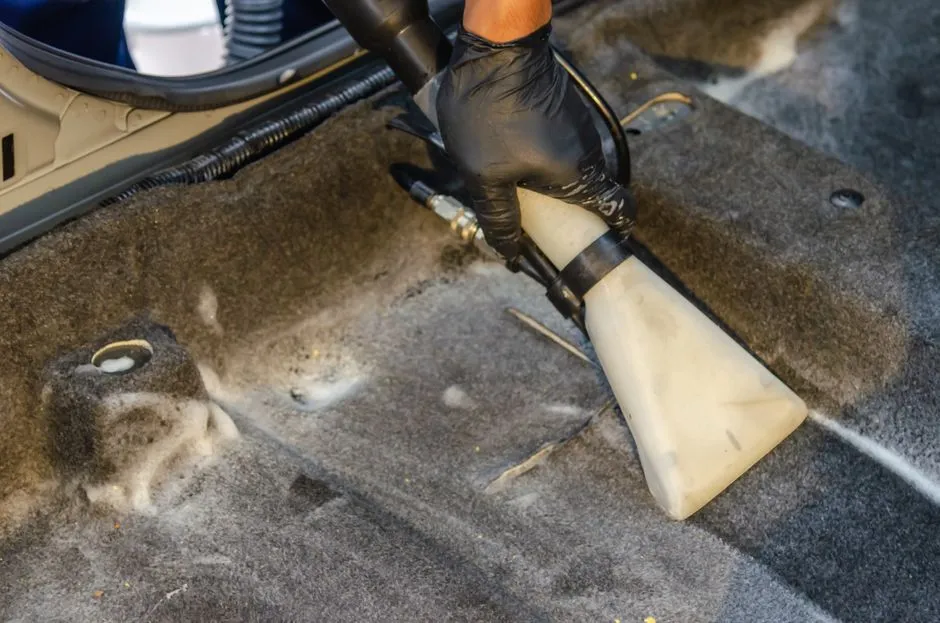
- Extract — pull the mats, lift carpet where needed, and run a commercial extractor to draw moisture and spores out of the fabric and padding.
- Treat with proper anti-microbial solutions, then steam the hard surfaces to sanitise them.
- Sort the AC with an anti-bacterial fogger through the vents and evaporator — the bit you can't do at home.
- Dry it out properly with industrial fans and a dehumidifier before we close it up.
- Protect — condition the leather and add a fabric protectant to slow it down next time.
It's usually 4–6 hours for a standard car, and runs $250–$600 depending on how far it's gone and the size of the vehicle. Honestly, most of that cost is the drying and the AC work — not the scrubbing — which is exactly the part you can't really do yourself.

Stopping it coming back
Getting rid of mould is the easy part. Keeping it gone through a Cairns wet season is the real trick. This is what we tell every client.
Keep it dry
- Never leave wet things in the car — towels, gym gear, umbrellas, wet shoes. Out they come, every time.
- Swap to rubber mats over the wet months. They don't drink up water the way carpet ones do.
- Run the AC on fresh air for the last few minutes before you park — it helps dry the evaporator.
- Pop a moisture absorber (DampRid or a silica pack) under each seat. About $5–$10, swap monthly.
Keep it clean and protected
- A proper interior detail every couple of months clears the dust and skin oils mould actually feeds on.
- Condition the leather a few times a year — dried-out, cracked leather grows mould far more readily.
- Park in the sun when you can. An hour of Cairns sun does more for mould than most products on the shelf.
The spots people always miss
Most people only spot mould once it's on the seats or the wheel. Here's where it actually likes to hide:
- Under the seats, where the rails trap crumbs and damp.
- Seat-belt webbing — pull the full belt out and have a look.
- The headlining — heat rises, condensation forms on the roof, and it's the last place anyone checks.
- AC vents — shine a torch in; fuzzy growth means the system needs treating.
- The spare-tyre well, where water sneaks in past tail-light and boot seals.
In the wet, it's worth a two-minute check of these spots once a month. Catching it early is the difference between a 20-minute job and a $500 one.
Questions we get asked a lot
Can I remove car mould myself?
If it's light surface mould on the seats, wheel or dash — yes, and you should. A HEPA vacuum, a 50/50 white vinegar spray, and a few hours drying in the sun will do it. It's when the mould's into the carpet underlay, headlining or AC that it's worth a professional.
Does vinegar actually kill car mould?
It does — white vinegar kills roughly 82% of mould species and is safe on most interior surfaces, which is why we use it over bleach. Equal parts vinegar and water, leave it 10–15 minutes, then wipe off with clean microfibre.
Why does my car keep getting mould?
Because the moisture's still getting in somewhere. Mould only needs damp to grow, so if it's back within weeks it's usually water trapped in the carpet padding, a small leak, or mould sitting in the AC you can't reach with a spray.
Is mould in a car dangerous?
It's an irritant rather than an emergency. The spores trigger allergies and asthma, and your AC recirculates them through the cabin — so even the mould you can't see, you're breathing. Worth treating the cause, not just the patch you can see.
How much does professional mould removal cost?
Usually $250–$600 in Cairns, depending on how far it's spread and the size of the car. Most of that is the deep extraction, AC treatment and drying — the parts that are hard to do at home.
How do I keep it away in the wet season?
Keep it dry: no wet towels or shoes left in the car, rubber mats instead of carpet, AC on fresh air before you park, and a moisture absorber under each seat. Sun and airflow beat any product on the shelf.

Mould got the better of it?
Send us a photo and we'll tell you honestly whether you can sort it yourself or it's one for us. Mobile across Cairns, no drama either way.
Call 0468 077 474