

Ceramic Coating vs Paint Protection Film: Which Do You Need in Cairns?
We get this one on the phone a lot, usually from someone who's been quoted both and isn't sure which they're being sold. It's a fair question, because the two get lumped together as "paint protection" when they do genuinely different jobs. So here's the plain version from someone whose team coats and films cars in the Cairns heat every week, no pitch attached.
The one difference that decides everything
Most of the confusion clears up the second you split protection into two kinds: chemical and physical.
Ceramic coating handles the chemical and environmental side — UV, salt air, oxidation, bird and bat droppings, sap, bug splatter. It bonds into the paint and makes the surface slick, so water beads off and grime doesn't grab on.
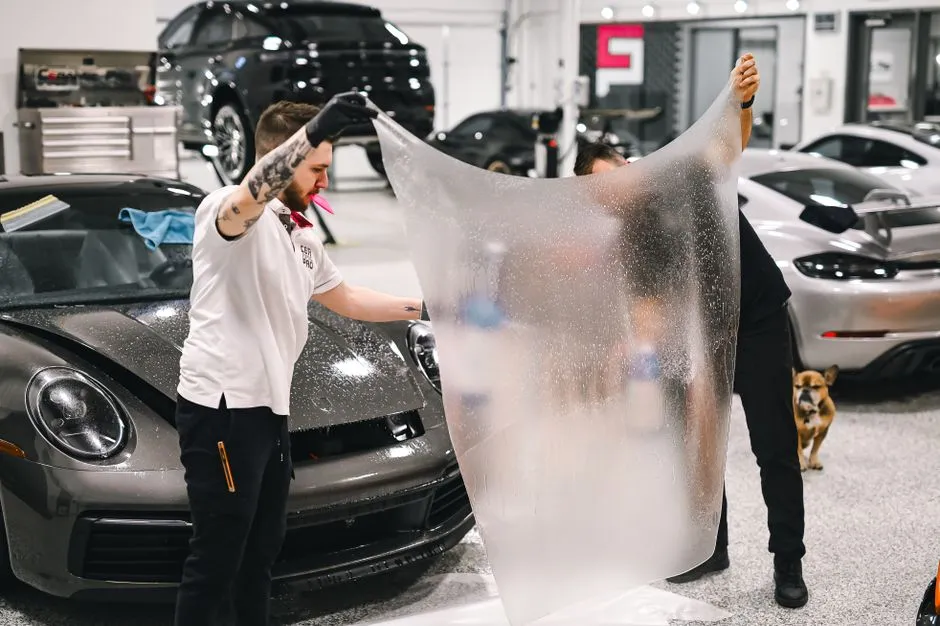
PPF handles the physical side — rock chips, gravel rash, light scratches, the odd trolley nudge. It's a thick, clear film that physically absorbs the hit so the paint underneath stays untouched.
Different problems, different tools. Some cars only need one, and some are best off with both, if that makes sense.
What ceramic coating actually does
The way I like to explain it: a ceramic coating is basically a second, much stronger clear coat. It's a liquid polymer that bonds into the paint, so from then on the salt, the UV and the bird bombs hit the coating instead of the paint itself.
What it's good at:
- UV damage. This is the big one in Cairns. UV breaks down clear coat and fades paint, and a coating is about the best defence going short of a 24/7 garage. We see cars only two or three years old already oxidising up here.
- The nasty stuff. Bird and bat droppings, sap, salt spray, bug guts — all of it etches bare paint, and on a coated car most of it wipes off with a damp cloth before it can do harm.
- Salt air. Live anywhere near the coast and salt's settling on the car every day. The coating gives it a barrier to sit on instead of the paint.
- Beading and shine. Water rolls off, the car stays cleaner for longer and washes in half the time, and you get a deep, glassy finish wax can't match.
What it won't do is stop a rock chip, a key down the door or a trolley ding. A coating is hard, but it's microns thin — bulletproof to bird bombs, not to gravel. If physical damage is your worry, ceramic isn't the answer to it.
What paint protection film actually does
Paint protection film is a thick, clear urethane film laid over the panels that cop the most punishment. Think of it like a screen protector, but for your bonnet — it takes the damage so the paint doesn't.
What it's good at:
- Rock chips. The number one reason people get film. If you're regularly on the Captain Cook Highway up to Port Douglas, or running gravel out to the Tablelands, your front end takes a constant peppering of stones and road grit, and film soaks that up.
- Light scratches. Car-park scrapes, branches, general contact — the film wears instead of the clear coat.
- Self-healing. The good films have a top layer that closes light marks back up with a bit of heat, and in this climate the sun does that for you.
What film doesn't really give you is the slick, water-beading, washes-itself feeling of a coating, or the same depth of shine. Most films have UV inhibitors built in these days, so they're not defenceless against the sun, but UV and the chemical stuff isn't what film is for — that's the coating's department.
The two side by side
If you just want the quick read on what each one's for, here it is.
| Factor | Ceramic coating | Paint protection film |
|---|---|---|
| Rock chips & impacts | No real help | Excellent |
| UV & fading | Excellent | Good (built-in inhibitors) |
| Salt, bird mess, sap | Excellent | Good |
| Water beading & easy washing | Excellent | Mild |
| Depth of shine | Deep, glassy | Keeps the factory look |
| Light scratches | Shrugs off swirls | Self-heals (good films) |
| How long it lasts | Years | Many years |
| Typical cost in Cairns | From ~$1,000 | A few thousand and up |
Why the tropics tip it toward ceramic
Here's where I get a bit opinionated. In a lot of the country this would be a closer call, but Cairns isn't most of the country.
The UV up here regularly hits 13 or 14 in summer — that's "extreme" on the scale, where down south sits around 6 to 8. Then there's the salt off the coast, the humidity sitting at 85% and up through the wet, and the bird and bat mess that etches bare paint within a day or two in this heat. Every one of those is a chemical attack, and a chemical attack is exactly what a coating is built to hold off. Day to day, that's what's quietly ageing most cars in Cairns — not the occasional rock.
Film is brilliant at what it does, but it's a fix for a problem most daily drivers around town don't have a lot of. Unless you're on the highway or gravel a fair bit, the rocks aren't your main threat — the climate is. That's why, nine times out of ten, the ceramic is where we'd start.
What each one costs up here
Let's talk numbers, because that's usually the bit people are circling. These are the going rates around Cairns, not just us — your actual price moves with the size of the car and the state of the paint.
| Job | Rough cost in Cairns |
|---|---|
| Ceramic coating (new car, prepped & coated) | from ~$1,000 |
| Ceramic coating (used car — needs correction first) | from ~$1,325 |
| PPF — front end only (bonnet, bumper, mirrors) | a couple of thousand |
| PPF — full-car wrap | several thousand and up |
| Dealership "paint protection" package | $2,000 – $4,000 |
So a ceramic coating is the gentler entry point, and on a car you're keeping a while it tends to work out cheaper than waxing your way through three Cairns summers and still needing a correction at the end of it. Film is the bigger spend, which is part of why most people film only the front end that takes the rocks rather than wrap the whole car.
When it's worth doing both
If the budget stretches, doing both is the setup we'd quietly pick for our own cars.
Film goes on the high-impact panels — bonnet, front bumper, mirrors, sometimes the door edges and the strips behind the wheels that catch the gravel. Then a ceramic coating goes over the entire car, the film included. The film takes the rock chips, the coating takes the UV, the salt and the bird mess everywhere, and the whole car beads water and washes easier. You're covering the physical and the chemical at the same time.
It's the dearest way to go, no getting around that. We'd only point you there if you're keeping the car a good while and you're doing the kilometres to justify the film — otherwise the coating on its own is plenty.
How to tell you're being sold the real thing
A quick heads-up, because this comes up on the phone constantly. Whether it's ceramic or film, the price tells you almost nothing about the quality — a $3,000 dealership "paint protection" package can be a genuine coating, or it can be a spray sealant in a nicer box. The trick is knowing what to ask so you can tell which one you're being handed.
I won't point fingers at anyone, and plenty of operators do it properly. But a real ceramic coating takes the better part of a day — the paint gets cut and polished first, the coating laid on in clean conditions, then it needs time to cure undercover. A real PPF job is slow, careful work in a clean, controlled space. So if a "ceramic" is done in an hour while you wait, with no correction beforehand and nobody able to tell you the product or the warranty, be a bit sceptical about what you're actually getting.
Which one your car actually needs
Here's the part where I talk you out of spending more than you have to, because the right answer really does depend on how you use the car.
If you're a daily driver mostly around town, parked outside, keeping the car a few years — a ceramic coating on its own is almost always the smart spend. The climate's your enemy, not rocks, and that's exactly what it's for.
If you're on the highway or gravel a lot, or you've just picked up a new car you want to keep mint, that's where film on the front end starts to earn its place, with a coating over the top.
And I'll be honest with you about when to keep your money in your pocket. If you're selling the car in the next few months, neither one's worth it — a good pre-sale detail does the job for a fraction of the cost. If it lives in a garage and barely gets driven, shade is already the best protection there is, so a tidy detail now and then is plenty. And if you genuinely love washing your own car and you'll keep on top of it, a good sealant a few times a year will hold the fort — you don't strictly need either of these. For the full breakdown of where we sit, the price list is all there.
Questions we get asked a lot
Is ceramic coating or PPF better in Cairns?
They guard against different things, so it depends on what's wrecking your car. For most people up here the enemy is the climate — UV, salt air, bird and bat mess — and that's a ceramic coating's job. If your real worry is rock chips from the highway out to Port Douglas or the Tablelands, that's a PPF job. A lot of cars only need the ceramic.
Does ceramic coating stop rock chips?
No. A coating is a tough chemical barrier, not a cushion. A rock off the highway will chip a coated car the same as a bare one. If rock chips are your concern, that's what paint protection film is for — a thick film that physically takes the hit instead of your paint.
Can you put ceramic coating over PPF?
Yes, and it's the best of both. Film goes on the front end that cops the rocks, then a ceramic coating goes over the whole car, film included. The film handles the impacts, the coating handles the UV, salt and bird mess everywhere, and the whole car beads water and washes easier.
How much does ceramic coating cost in Cairns?
A proper professional coating starts from around $1,000 for a small new car and climbs with the size of the vehicle and the state of the paint; a used car that needs correcting first starts a bit higher. Dealerships often want $2,000 to $4,000 for the same idea, sometimes for what's really a glorified sealant.
How much does paint protection film cost?
PPF is the dearer of the two because it's slow, precise work. Covering just the front end — bonnet, bumper, mirrors — usually runs a couple of thousand dollars, and a full-car wrap climbs to several thousand and up. That's why most people only film the high-impact panels and ceramic the rest.
Do I really need both?
Most people don't. If you park outside in Cairns and you're keeping the car, a ceramic coating earns its keep on its own. Film only really pays off if you're racking up highway or gravel kilometres, or you've got a new car you want to keep mint. Send me a photo and tell me how you drive and I'll tell you straight which camp you're in.

Not sure which one your car needs?
Send us a photo of your paint and tell us how you drive, and we'll tell you honestly whether it's ceramic, film, both, or neither. Mobile across Cairns, no pressure either way.
Call 0468 077 474